In This Article
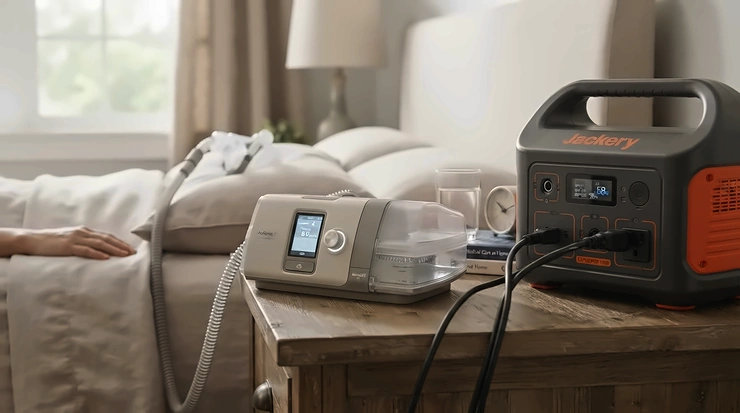
A portable power station for CPAP machine overnight is a rechargeable lithium battery with built-in AC and DC outlets. It keeps your sleep apnea therapy running when the grid fails or the campsite has no hookup. Capacity is measured in watt-hours, so choose one that covers your machine, your humidifier, and a safety buffer.
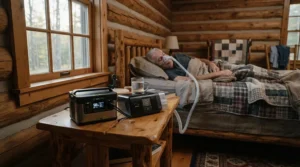
Picture the scene. It’s 2 a.m., a storm has taken out the grid, the fridge has gone quiet, and your CPAP just sighed its last breath. Nobody goes to bed planning to become a watt-hour expert. But when therapy depends on electricity, you learn the math now or at 2 a.m. The good news: choosing a portable power station for CPAP machine overnight is far simpler than the spec sheets make it look.
Positive airway pressure therapy is a common and effective sleep apnea treatment, according to the NHLBI, and it only works while the air keeps flowing. A small lithium battery is the gap between a restful night and a very long, very groggy next day. This guide covers seven units worth your attention. It also covers how CPAP power consumption really behaves, why a pure sine wave power station for CPAP matters, where a DC adapter for CPAP saves energy, and how to plan CPAP battery backup for camping trips.
One honesty note before we dive in. Everything here comes from manufacturer specs, published reviews, and retailer-listed owner feedback, not bench tests of my own. Treat runtime figures as planning estimates, run a full dry night at home, and confirm any medical decisions with your sleep clinician.
Quick Comparison: Portable Power Station for CPAP Machine Overnight Picks at a Glance
| Product | Capacity | AC Output | Weight | Price Range | Best For |
|---|---|---|---|---|---|
| EcoFlow River 3 Plus | 286Wh | 600W pure sine | 10.4 lb | ~$230–$450 | Blackout backup with fast UPS switchover |
| Jackery Explorer 300 Plus | 288Wh | 300W | ~8 lb | ~$250–$300 | Light weekend trips |
| Bluetti EB3A | 268Wh | 600W pure sine | 10.1 lb | ~$220–$270 | Tightest budget |
| Anker SOLIX C300 DC | 288Wh | None (DC only, 300W total) | 6.2 lb | ~$150–$250 | DC-adapter setups |
| Bluetti AC70 | 768Wh | 1,000W pure sine | 22.5 lb | ~$360–$500 | Multi-night camping |
| Jackery Explorer 1000 v2 | 1,070Wh | 1,500W | 23.8 lb | ~$500–$800 | Humidifier on all week |
| Anker SOLIX C1000 Gen 2 | 1,024Wh | 2,000W | ~25 lb | ~$500–$800 | Fastest recharge |
Looking at the table, the capacity gap is the story. The 268Wh–288Wh group (EB3A, Explorer 300 Plus, C300 DC, River 3 Plus) is built for one night or a few nights with the humidifier off. The AC70 is the budget bridge to multi-night use, and the Explorer 1000 v2 and C1000 Gen 2 are the “forget about it for a week” tier. Prices are ranges from the time of research and will shift, so check current pricing before you decide.
💬 Just one click — help others make better buying decisions too!😊
Top 7 Portable Power Station for CPAP Machine Overnight Picks: Expert Analysis
Each pick below gets the same treatment: what the specs mean at 2 a.m., who the unit suits, what reviewers say, and where it falls short.
1. EcoFlow River 3 Plus — best for blackout-ready backup
The standout is the sub-10-millisecond UPS switchover EcoFlow lists. When wall power drops, the unit takes over so quickly that your CPAP is far less likely to notice. That is exactly what you want from a portable power station for CPAP machine overnight use at home.
Specs: a 286Wh LiFePO4 battery, 600W pure sine wave AC (up to 1,200W through X-Boost in the app), a rated noise level under 30dB, and about 10.4 pounds. With a humidifier averaging around 25W, expect roughly nine to ten hours on AC after losses. Skip the humidifier and you’re looking at about three nights. The sleeper feature is expandability: EcoFlow’s EB300 or EB600 batteries stack the system up to 858Wh, so you can buy small and grow if outages get longer.
Reviewers at PhoneArena and StorageReview largely credit the 600W output, one-hour wall recharge, and expansion ports. I couldn’t verify a large pool of owner ratings, so weigh that accordingly.
Pros:
- ✅ Sub-10ms UPS switchover for blackout protection
- ✅ Expandable to 858Wh as needs grow
- ✅ Quiet fan rating suits a bedside spot
Cons:
- ❌ Humidifier plus heated tube drains it before morning
- ❌ List pricing climbs well above promo pricing
Price range: roughly the low $200s to mid-$400s depending on promotions. Strong value if blackouts, not camping, are your main worry.
2. Jackery Explorer 300 Plus — lightest LiFePO4 starter
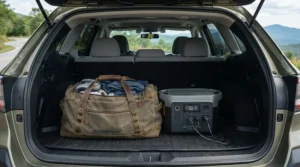
This is the easy-carry option. At roughly 8 pounds (retail listings vary slightly) with a 288Wh LiFePO4 battery, it slips into a tent bag without a second thought. The 300W AC ceiling sounds modest, but a CPAP typically draws a fraction of that, so you’re not short on power. You’re short on watt-hours, which is the number that matters for sleep.
In practice, with the humidifier off, plan on two to three nights. With a humidifier on, treat it as a one-night unit. One retailer listing shows a solar input of up to 200W and a recharge time near 1.35 hours, which helps for weekend trips.
Published product-page feedback on retailers like Galaxus praises the weight, compact size, and quiet operation. The recurring complaints are few connections, a USB-C port that gets blocked when solar charging, and the low power ceiling. Those are fair trade-offs for a CPAP-only buyer.
Pros:
- ✅ Genuinely light and compact for tent bags
- ✅ LiFePO4 chemistry with thousands of rated cycles
- ✅ Quiet operation reported by reviewers
Cons:
- ❌ One humidified night, then you’re recharging
- ❌ Limited ports and a 300W ceiling
Price range: around $250–$300. A good value verdict for light travelers and dry-air sleepers.
3. Bluetti EB3A — most affordable pure sine entry
The EB3A earns its place by pairing a 600W pure sine wave inverter with a small price. That’s unusual in this size class. The 268Wh LiFePO4 battery is rated for 2,500+ cycles, and Bluetti’s own formula (capacity × 90% depth × 90% efficiency) gives you a quick runtime sanity check.
At about 10 pounds it’s heavier than the Explorer 300 Plus but cheaper. Turbo charging reaches roughly 430W when AC and solar are combined. One retailer lists a UPS-style switchover near 20 milliseconds. That’s workable, though slower than the River 3 Plus, so expect a possible CPAP restart during a blackout.
Verified-owner comments on retailer pages mention overnight CPAP use and quick recharging. That’s anecdotal, not a controlled test, but it matches the specs. Bluetti’s FAQ also states the EB3A can’t be expanded with B230/B300 batteries.
Pros:
- ✅ Pure sine wave output at a budget price
- ✅ Fast turbo recharging with AC plus solar
- ✅ 2,500+ cycle LiFePO4 battery
Cons:
- ❌ No expansion path if your needs grow
- ❌ Slower switchover than premium UPS designs
Price range: around $220–$270. A smart-money pick for one humidified night or a couple of dry ones.
4. Anker SOLIX C300 DC — lightest pick for DC-first setups
The C300 DC is the odd duck here, and that’s the point. It has no AC outlets, just a 12V car socket, USB-C ports (two at 140W), and a 288Wh LiFePO4 battery in about 6.2 pounds. Pair it with your machine’s own DC converter and you skip the inverter entirely. That is the efficiency play covered in the DC adapter for CPAP section below.
The spec sheet lists a discharge range of -4°F to 104°F and up to 100W of solar input. Retailer specs list no UPS function, so it’s a camping and travel unit, not a blackout bridge. Confirm the 12V socket’s amp rating before you buy, because CPAP converters can pull close to 8 amps at 12V.
I couldn’t find enough independent reviews of this DC model to summarize owner sentiment honestly. For context, CyberShack’s review of its AC sibling praised value with low-power loads. That sibling ran a 50W CPAP for roughly five hours in their figures.
Pros:
- ✅ Featherweight at about 6.2 pounds
- ✅ Skips AC inverter losses with a DC converter
- ✅ Wide discharge temperature range for cold camps
Cons:
- ❌ No AC outlets for your machine’s stock adapter
- ❌ No UPS function for blackout switchover
Price range: typically listed around $150–$250 for the unit alone. Great value if you buy the right DC converter and commit to the DC path.
5. Bluetti AC70 — mid-range sweet spot for multi-night trips
This is where overnight CPAP backup stops feeling nervous. The AC70 carries 768Wh of LiFePO4 capacity, 1,000W of pure sine wave AC (2,000W in Power Lifting Mode), a 12V/10A car outlet, and 950W turbo charging that reaches about 80% in 45 minutes. Weight is about 22.5 pounds, so it’s more “car trunk” than “backpack.”
At an average draw of 25W, the math lands near three nights per charge with a humidifier. Skip humidification and you stretch toward a full week. TechRadar’s review found it handled everything within its 1,000W range without trouble and ran quietly. That fits a bedside CPAP.
On Bluetti’s own storefront, ratings skew heavily toward five stars (roughly nine in ten reviews at the time of research). That’s vendor-hosted feedback, so read it with a pinch of salt. The unit also has a 12V DC output that works with a ResMed-style converter.
Pros:
- ✅ Three-plus nights with humidifier on
- ✅ Pure sine wave AC plus a 12V/10A DC port
- ✅ Very fast turbo recharging
Cons:
- ❌ Heavy at roughly 22.5 pounds
- ❌ No weather-resistance rating in specs I found
Price range: roughly $360–$500. Excellent value for campers and outage-prone homes.
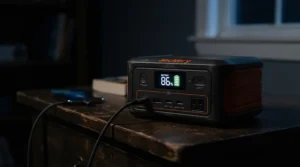
6. Jackery Explorer 1000 v2 — multi-night champion
If you want to stop doing math every evening, this is the one. The Explorer 1000 v2 packs 1,070Wh of LiFePO4 capacity, 1,500W AC (3,000W surge), a one-hour fast charge, up to 400W of solar input, and a 4,000-cycle rating to 70% capacity. It weighs about 23.8 pounds.
At 25W average, expect roughly four to five nights of humidified therapy. With the humidifier off, it can stretch to more than a week. TechRadar’s review praised its mains-style power and near-silent running. It also flagged the price and the lack of weatherproofing as the main cons.
For a CPAP-only buyer, the 1,500W ceiling is wildly more than you need. You’re paying for runtime and the option to also run a fridge or a laptop. Whether that’s smart depends on how often your area loses power.
Pros:
- ✅ About a week of dry-therapy nights per charge
- ✅ One-hour fast recharge between outages
- ✅ 4,000-cycle battery rating
Cons:
- ❌ Not weatherproofed per published reviews
- ❌ Overbuilt if CPAP is your only load
Price range: roughly $500–$800 depending on promotions. Premium value for households that want zero overnight anxiety.
7. Anker SOLIX C1000 Gen 2 — fastest recharge for repeat outages
The C1000 Gen 2 is a bit of a speed demon. It offers 1,024Wh, 2,000W continuous output (3,000W surge), and a 10ms UPS rating. Anker’s HyperFlash charging claims a full recharge in about 49 minutes at 1,600W from the wall, and it accepts up to 600W of solar.
That fast charge changes the strategy. In a rolling outage you can top up quickly whenever power flickers back. Its 4,000-cycle battery and five-year warranty add long-term confidence. At about 25 pounds it’s a home-and-vehicle unit, not a backpack unit.
Independent review coverage I found was thin, with most roundups repeating the 49-minute figure. One retailer listing cites noise under 20dB at lighter loads, which I’d treat as unverified marketing until you hear it yourself.
Pros:
- ✅ 49-minute fast recharge claim
- ✅ 10ms UPS switchover for blackout protection
- ✅ 5-year warranty and 4,000-cycle battery
Cons:
- ❌ Heavy to move around a campsite
- ❌ Premium price for a CPAP-only load
Price range: roughly $500–$800 depending on promotions. Best for storm-prone homes that need to recharge between flickers.
How to Choose a Portable Power Station for CPAP Machine Overnight
Choosing a portable power station for CPAP machine overnight use comes down to six decisions. Here they are in order:
- Measure your real draw. Plug your CPAP into a watt meter with your humidifier and heated tube set as you sleep. Published figures disagree wildly, so your own reading beats every chart.
- Convert to nightly watt-hours. Multiply average watts by sleep hours, then add about 15% for AC conversion losses.
- Multiply by nights without a recharge. Then add a 20% buffer, because cold weather and aging cells both cost capacity.
- Confirm pure sine wave output. It’s a spec-sheet line, and it matters for sensitive electronics.
- Check the outputs you’ll use. If you plan a DC adapter for CPAP, verify a regulated 12V port with enough amps. If blackouts are the goal, look for a UPS rating.
- Weigh weight, noise, and recharge speed. A unit you hate carrying or hearing is a unit you’ll avoid using.
Notice what’s missing: peak wattage. For a CPAP, output ceiling is almost never the limiting factor. Watt-hours are.
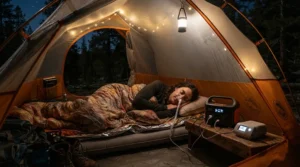
CPAP Power Consumption: What Your Machine Really Draws
CPAP power consumption is the most misunderstood number in this whole topic. Published figures range from single digits to about 90W, and both ends can be right depending on settings.
Here’s why. Blower-only draw can sit near 7–10W at modest pressures, according to bench figures and user reports. Vendor guides often quote 30–60W as a “typical” CPAP range, which probably reflects worst-case or humidified use. The ResMed AirSense 11’s power supply is listed at about 56W typical and 73W peak, but that is the supply’s rating, not your nightly average.
What nudges your number up or down? Higher prescribed pressure, mask leaks (a leaking mask makes the blower work harder), cold bedroom air, and, above all, heating. The spec sheet won’t tell you this, but a leak-free mask can quietly shave watts, so fixing leaks is free runtime.
The practical rule is simple: measure, don’t guess. Write down your average watts over a full night, multiply by hours, and you have the number every other calculation in this guide depends on.
Heated Humidifier Draw: The Hidden Battery Hog
Heated humidifier draw is the single biggest runtime lever you control. Guides commonly put the humidifier at roughly 25–35W, and some estimates run higher. A heated tube can add another 5–15W depending on its setting.
One set of bench figures shows how fast that stacks up. About 7W for the device alone becomes about 22W with the humidifier on, and about 34W with a heated tube too. Over eight hours that’s roughly 56Wh, 176Wh, and 272Wh. Same machine, nearly five times the energy. Several vendor guides estimate the humidifier alone can cut runtime by 40–60%.
So what do you do on a camping trip or in a long outage?
- Lower the humidity setting instead of switching heat off entirely.
- Skip the heated tube when the bedroom is warm.
- Size the battery for your real setup, not the idealized one.
Talk to your clinician before dropping humidification altogether, since dryness can make therapy uncomfortable. Treat heated humidifier draw as a dial you adjust, not a switch you flip.
Pure Sine Wave Power Station for CPAP: Why Waveform Matters
A pure sine wave power station for CPAP delivers AC power shaped like the smooth curve your wall outlet provides. Cheaper inverters produce a stepped “modified” wave, which can make sensitive electronics hum, run warm, or behave oddly.
Your CPAP’s AC adapter is a switching power supply built for 100–240V, 50–60Hz wall power. Feeding it a clean waveform removes one variable from a night where you’d prefer zero surprises. That’s the reasoning behind nearly every roundup pointing CPAP buyers toward pure sine wave output.
Several units here, like the River 3 Plus, EB3A, and AC70, explicitly list pure sine wave AC. The C300 DC sidesteps the question by having no AC output at all. For the others, confirm waveform on the spec sheet before buying, since I couldn’t verify it for every model in the sources I found.
A pure sine wave power station for CPAP isn’t a luxury feature. It’s the baseline, and thankfully most mainstream lithium units in this size class meet it. Just don’t assume. Read the line item.
DC Adapter for CPAP: The Efficiency Shortcut
A DC adapter for CPAP lets your machine run straight off the battery’s 12V port, skipping the inverter and the stock AC brick. For ResMed’s AirSense 11 family, the official converter accepts 12V or 24V input and outputs 24V. It’s rated up to 90W and supports the HumidAir humidifier and ClimateLineAir heated tube.
Why bother? Every AC conversion wastes energy. One CPAP forum user’s bench test measured the stock adapter plus a sine-wave inverter at roughly 64–70% efficient, versus about 72–78% for the DC/DC route. That’s a single user’s measurement, not a lab standard, but the direction makes physical sense. Fewer conversions, less waste.
Check three things before buying:
- Compatibility. Converters are model-specific. A ResMed 11 converter won’t fit older series, and other brands differ, so read your machine’s label.
- Port capacity. A 12V/10A port (about 120W) has headroom, while a 12V/5A port doesn’t.
- Price. ResMed-style converters are typically listed in the roughly $100–$200 range.
Used well, a DC adapter for CPAP can stretch a 288Wh unit noticeably further.
CPAP Battery Backup for Camping Trips: A Practical Plan
CPAP battery backup for camping trips fails for boring reasons: cold, damp, and optimism. Here’s how to avoid all three.
Cold. Lithium cells charge poorly below freezing. The C300 DC lists charging from 32°F to 104°F, so a frosty morning solar top-up may refuse to start. Sleep with the unit somewhere above freezing and charge it indoors or in the car cabin.
Damp. Keep it off wet ground and out of tent condensation. The River 3 Plus lists an IP54 rating on one European retailer page, while TechRadar notes the Explorer 1000 v2 isn’t weatherproofed. Treat the rest as indoor gear.
Optimism. Budget runtime from your measured draw, not hope. A three-night tent trip at an average 25W needs about 600Wh before losses, or roughly 690Wh with them. That’s why the AC70 fits so neatly. If you’re solar-charging, a 100W panel takes roughly three to four hours to refill a 288Wh unit in good sun, per one retailer’s figures, so don’t count on a full recharge every afternoon.
Finally, rehearse. Run a complete night at home with your exact settings before you drive anywhere remote.
Runtime Math: How Many Nights Will Each Pick Last?
These estimates use average CPAP draws of 10W (humidifier off), 25W (humidifier on), and 40W (humidifier plus heated tube). They assume about 87% AC efficiency and an 8-hour night. This is my own arithmetic, not a lab test.
| Product | 10W (nights) | 25W (nights) | 40W (nights) |
|---|---|---|---|
| Bluetti EB3A (268Wh) | ~2.9 | ~1.2 | ~0.7 |
| EcoFlow River 3 Plus (286Wh) | ~3.1 | ~1.2 | ~0.8 |
| Jackery Explorer 300 Plus (288Wh) | ~3.1 | ~1.3 | ~0.8 |
| Bluetti AC70 (768Wh) | ~8.3 | ~3.3 | ~2.1 |
| Anker SOLIX C1000 Gen 2 (1,024Wh) | ~11 | ~4.5 | ~2.8 |
| Jackery Explorer 1000 v2 (1,070Wh) | ~11.6 | ~4.7 | ~2.9 |
The table makes one thing painfully clear: the small units are one-night wonders the moment you add a heated tube. The AC70 is the best value jump, tripling the humidified runtime for a modest premium. Using a DC adapter for CPAP would improve every figure a little, so treat these as conservative.
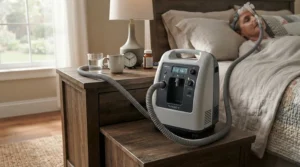
Portable Power Station vs Dedicated CPAP Battery vs Generator
| Option | Capacity | Noise & Fumes | Best For |
|---|---|---|---|
| Portable power station | 250Wh–2,000Wh+ | Near-silent, no exhaust | Home backup, camping, multi-use |
| Dedicated CPAP battery pack | ~160Wh–300Wh | Silent | Short trips, flights where allowed |
| Small gas generator | Fuel-dependent | Loud, carbon monoxide risk | Whole-site power, outdoors only |
Dedicated CPAP batteries are purpose-built, often with the right connectors and cables included, which is genuinely convenient. The trade-off is flexibility. A power station also charges your phone, runs a light, and keeps the router alive during an outage, so it earns its keep outside bedtime.
Generators are the cautionary tale. They’re noisy, need fuel, and must never run indoors or near windows because of carbon monoxide. For a sleeper, silence and zero fumes are features, not extras. That’s why a lithium portable power station for CPAP machine overnight use usually beats a generator for bedside duty.
Setup Guide: Your First 30 Days With a Portable Power Station for CPAP Machine Overnight
Treat the first month as a dress rehearsal. Do it in this order:
- Charge to 100% before first use, then let the unit rest.
- Run a full dry night on battery at home with your normal humidifier and tube settings. Note the morning percentage.
- Switch off unused outputs (USB, lights, DC ports) to cut idle drain.
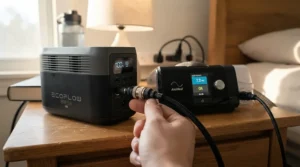
- Place the unit off the bed, on a hard surface with airflow, and route cables so you can’t snag them in your sleep.
- Log your numbers. Starting percentage, ending percentage, room temperature, humidifier setting. After three nights you’ll know your real runtime.
- Set a recharge routine. Top up after any outage or trip, and recharge stored units to roughly 40–60% every three to six months, per Bluetti’s AC70 spec notes.
Common first-month mistakes include forgetting to recharge after the last outage, assuming the app’s runtime estimate covers a heated tube, and discovering during a trip that the converter cable doesn’t match the machine.
Real-World Scenarios: Which Pick Fits Which Sleeper
The weekend tent camper (three nights, no hookup). A humidified CPAP at about 25W average needs roughly 690Wh once conversion losses are counted. The AC70 covers it with a thin but workable margin, and adding a DC converter widens it.
The storm-prone homeowner (one to two nights). Two nights at 25W is about 460Wh with losses, more than a stock River 3 Plus holds. Add the EB300 expansion battery and you’re covered, with UPS switchover as a bonus. The C1000 Gen 2 works if you’d rather buy one bigger unit and enjoy the 49-minute recharge between outages.
The van-lifer (a week, with solar). A week of humidified nights is about 1,400Wh before losses. Here the Explorer 1000 v2 with its 400W solar input makes sense, because daytime sun can refill what nighttime therapy spends.
The ultralight traveler (dry air, one night). A C300 DC plus a compatible DC converter keeps weight low and wastes less energy.
✨ Ready to Sleep Easier Off-Grid?
🔍 Take your nights away from the wall socket to the next level with these carefully selected power stations. Click any bolded product name to check current pricing and availability. These units can help you build a worry-free overnight setup your whole household will love! 🔋😴
Long-Term Cost & Maintenance
Lithium iron phosphate batteries change the ownership math. With ratings of roughly 2,500 to 4,000 cycles across the units here, a nightly partial discharge can last many years. A unit around $250 rated for 3,000 cycles works out to pennies per cycle, which makes the sticker price look much friendlier.
Real ownership costs are small but real:
- A DC converter if you take the DC route, typically $100–$200.
- A watt meter, worth buying before anything else.
- Replacement cables for your specific CPAP model.
Maintenance is mostly neglect prevention. Store the unit partially charged, away from heat, and top it up every few months. Check warranties too. Several brands here advertise multi-year coverage, such as the five-year terms listed for the C1000 Gen 2 and AC70, which is reassuring for a device tied to your sleep.
Compare that with disposable alternatives: gas for a generator, or replacing a dedicated CPAP battery pack that can’t pull double duty. Over a decade, a quality portable power station for CPAP machine overnight use tends to be the thriftier choice.
Safety, Regulations & Medical Planning
Start with the people who know your therapy. Federal preparedness guidance recommends talking to your medical provider about a power outage plan for electricity-dependent devices. The ADA National Network’s emergency power guide walks through planning for battery-dependent medical equipment and is worth a read.
A few practical safeguards:
- Register with your utility as a medical-device customer if they offer it.
- Keep the unit ventilated and off bedding.
- Never run a generator indoors. Carbon monoxide is silent and lethal.
- Know your backup to the backup, whether that’s a second battery, a fully charged car, or a friend’s spare room.
- Don’t treat any power station as a medical device. If your prescription is life-supporting, ask your clinician what level of redundancy they recommend.
Finally, check airline rules before flying with any of these. Units above roughly 100Wh generally can’t go in carry-on, so they’re road-trip gear, not flight gear.
FAQ
❓ How many watt-hours do I need for one night of CPAP?
❓ Will a power station keep my CPAP running through a blackout without a glitch?
❓ Do I need a DC adapter for CPAP if my power station has AC outlets?
❓ How much does a CPAP-ready power station cost in 2026?
❓ How should I store my power station between trips?
Conclusion
Choosing a portable power station for CPAP machine overnight use isn’t about the biggest number on the box. It’s about matching watt-hours to your real draw, and the humidifier and heated tube are usually the swing factor. Measure first, size second, buy third.
If you want a short answer: the Bluetti EB3A or Jackery Explorer 300 Plus suit one-night budget backup. The EcoFlow River 3 Plus adds fast UPS switchover and expansion. The Anker SOLIX C300 DC rewards DC-adapter fans. The Bluetti AC70 is the best value for multi-night camping, and the Jackery Explorer 1000 v2 and Anker SOLIX C1000 Gen 2 are the worry-free tier for outage-prone homes and long trips.
Whichever you pick, rehearse a full night at home, keep a plan B, and talk through your outage plan with your clinician. Ready.gov’s power outage guidance is a good checklist for the rest of the house.
Recommended for You
- [Add your blog post link 1]
- [Add your blog post link 2]
- [Add your blog post link 3]
Disclaimer: This article contains affiliate links. As an Amazon Associate, I earn from qualifying purchases. If you purchase products through these links, we may earn a small commission at no additional cost to you.
✨ Found this helpful? Share it with your friends! 💬🤗
